Table of Contents
- 1. Introduction
- 2. What is Kubernetes Architecture?
- 3. Cluster Architecture Overview
- 4. Control Plane Components
- 5. Worker Node Architecture
- 6. Pod and Service Networking
- 7. High Availability
- 8. Modern Improvements (1.29–1.35)
- 9. AI-Powered Operations
- 10. AI/ML Infrastructure Platform
- 11. Self-Healing
- 12. Security Posture Hardening
- 13. Modern DevOps Stack (2026)
- 14. Conclusion
1. Introduction
Kubernetes has become the undisputed standard platform for orchestrating containerized workloads in modern cloud infrastructure. As organizations scale their cloud-native applications and embrace AI/ML workloads, understanding Kubernetes architecture has become a non-negotiable skill for DevOps engineers.
This article provides a deep-dive into the core architecture of Kubernetes clusters, how requests flow through the system, and the modern architectural improvements introduced in Kubernetes 1.29 through 1.35 — including AI-powered operations, GPU scheduling, self-healing, and policy-as-code security.
2. What is Kubernetes Architecture?
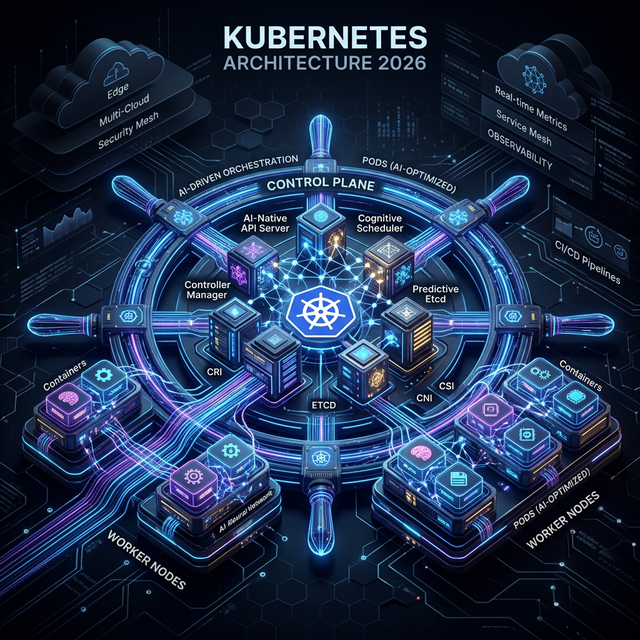
Kubernetes architecture defines the structure of a Kubernetes cluster and the interaction between its components. At its core, a Kubernetes cluster is composed of two major layers:
- Control Plane — Manages cluster state, scheduling, and API access
- Worker Nodes — Run the actual containerized workloads (Pods)
The control plane acts as the brain of the cluster, making decisions about where and how workloads run, while worker nodes are the muscle that actually executes them.
3. Kubernetes Cluster Architecture Overview
A typical production Kubernetes cluster follows a layered architecture:
Users / CI-CD Pipelines
       ↓
Ingress / Load Balancer
       ↓
API Server (Control Plane)
       ↓
Scheduler + Controllers
       ↓
Worker Nodes
       ↓
Pods (Containers)
Every interaction with the cluster — from kubectl commands to CI/CD deployments — flows through the API Server, which is the central control point for authentication, authorization, admission control, and state management.
4. Control Plane Components
The control plane is the brain of the Kubernetes cluster. It makes global decisions about scheduling, state reconciliation, and cluster management. In production, the control plane is replicated across multiple nodes for high availability.
kube-apiserver
The API Server is the single entry point for all cluster operations. It handles:
- Authentication and Authorization (RBAC, OIDC, tokens)
- Admission control (validating and mutating webhooks)
- API versioning and compatibility
etcd
etcd is the distributed key-value store that holds the entire cluster state. It stores cluster configuration, pod states, secrets, ConfigMaps, and all resource definitions.
kube-scheduler
The scheduler determines which node should run each new pod by evaluating resource availability, pod affinity/anti-affinity, taints/tolerations, and node selectors.
kube-controller-manager
Controllers maintain the desired state of the cluster through constant reconciliation loops (e.g., Node Controller, Deployment Controller).
5. Worker Node Architecture
Worker nodes run the actual workloads. Each node contains several critical components:
- kubelet: The primary node agent. Watches the API Server for PodSpecs and ensures the containers are running and healthy.
- kube-proxy: Manages network rules on each node to implement Kubernetes Service abstractions (via iptables, ipvs, or eBPF).
- Container Runtime: Responsible for pulling images and running containers (e.g., containerd or CRI-O).
6. Pod and Service Networking
Pods: The smallest deployable unit in Kubernetes. A pod contains one or more containers that share a network namespace and storage volumes.
Services: Provide stable networking endpoints for a dynamic set of pods (ClusterIP, NodePort, LoadBalancer, ExternalName).
Ingress: Manages HTTP/HTTPS routing into the cluster using controllers like NGINX, Traefik, or Gateway API implementations.
7. High Availability Kubernetes Architecture
Production clusters require multi-node control planes to survive node failures without downtime.
External Load Balancer
       ↓
Control Plane Node 1   Control Plane Node 2   Control Plane Node 3
       ↓                     ↓                     ↓
etcd Node 1          etcd Node 2          etcd Node 3
       ↓
Worker Nodes (N)
       ↓
Pods (Workloads)
Require 3 or more control plane nodes for quorum-based etcd and multi-zone distribution to survive cloud AZ failures.
8. Modern Kubernetes Improvements (1.29–1.35)
- In-Place Pod Resource Adjustment (1.35): Modify CPU and memory resource allocations on running pods without restarting them.
- Gang Scheduling for AI Workloads: Add native gang scheduling to the scheduler for distributed AI/ML training jobs where pods must start all at once.
- Node-Declared Feature Advertising: Nodes can advertise their hardware capabilities (GPU model, NVMe, RDMA).
9. AI-Powered Operations: AIOps on Kubernetes
In 2026, static threshold-based alerts are being replaced by intelligent systems that detect anomalies, predict failures, and remediate issues automatically.
ML models (Autoencoders, Isolation Forests) are trained continuously on cluster telemetry, making them adaptive to changing workload patterns. Platforms like Komodor's Klaudia and Dynatrace's Davis AI can deliver root cause analysis in 15–30 seconds.
10. Kubernetes as AI/ML Infrastructure Platform
Kubernetes has become the standard platform for running AI/ML workloads. In 2026, the heaviest use cases are MLOps platforms.
resources:
  limits:
    nvidia.com/gpu: 1
Tools like Kueue handle fair queuing for AI workloads, while the KAITO operator simplifies deploying LLMs (Llama, Mistral) on GPU nodes.
11. Self-Healing: From Native to AI-Augmented
Self-healing has evolved into a multi-layer system spanning native probes, operators, event-driven KEDA scaling, and AI-augmented auto-remediation.
12. Security Posture Hardening in 2026
Mature platforms enforce security at the primitive level using Policy-as-Code (Kyverno / OPA) and zero-trust Network Policies.
13. Modern DevOps Kubernetes Stack (2026)
A production-ready platform integrates tools across several layers: ArgoCD (GitOps), Cilium (eBPF Service Mesh), KEDA (Autoscaling), Kueue (AI Workloads), Prometheus+Loki+Tempo (Observability), and Kubecost (FinOps).
14. Conclusion
Kubernetes architecture in 2026 is far more than a container orchestrator. It has evolved into a comprehensive cloud-native platform supporting traditional microservices, AI/ML training pipelines, and LLM inference services.